

The 50/30/20 rule splits take-home pay into three parts: 50% for needs, 30% for wants and 20% for savings. On a salary of 10,000 AED that is 5,000 AED for needs, 3,000 for wants and 2,000 for savings. It is a starting point that is easy to remember, not a law that fits every household, and in the UAE the one thing that moves it most is rent.
The arithmetic on three salaries
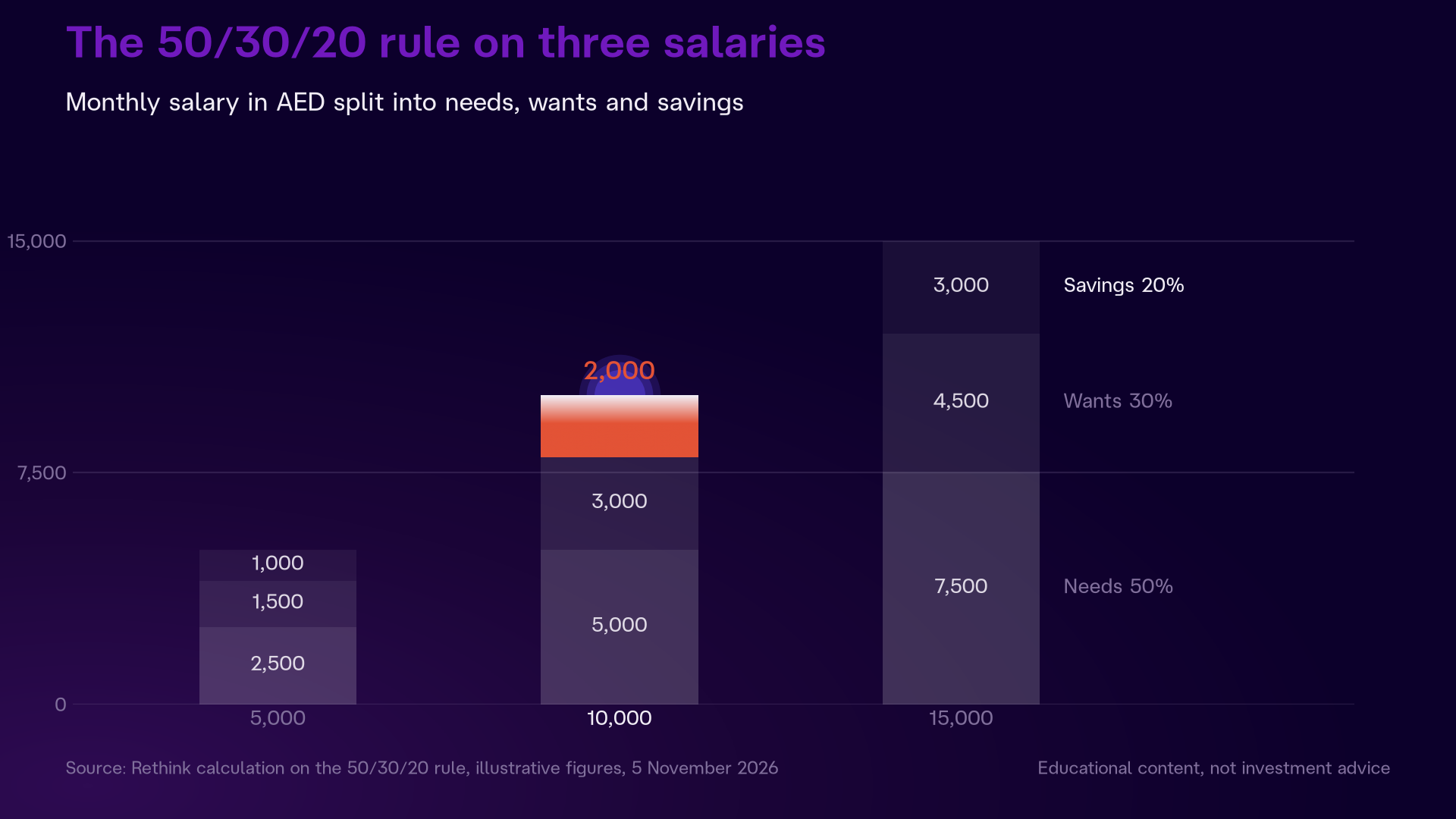
The rule works on the money that actually lands in the account, after any deductions. On three common salaries it gives:
- 5,000 AED: 2,500 for needs, 1,500 for wants, 1,000 for savings.
- 10,000 AED: 5,000 for needs, 3,000 for wants, 2,000 for savings.
- 15,000 AED: 7,500 for needs, 4,500 for wants, 3,000 for savings.
Needs are what the household stops without: rent, electricity and water, transport, groceries, phone, insurance, and binding instalments. Wants are everything that makes the month nicer and can wait: restaurants, subscriptions, travel, and clothes beyond need. Savings is what leaves the salary and does not come back the same month: the emergency fund first, then any goal further out.
Why rent changes the rule in the UAE
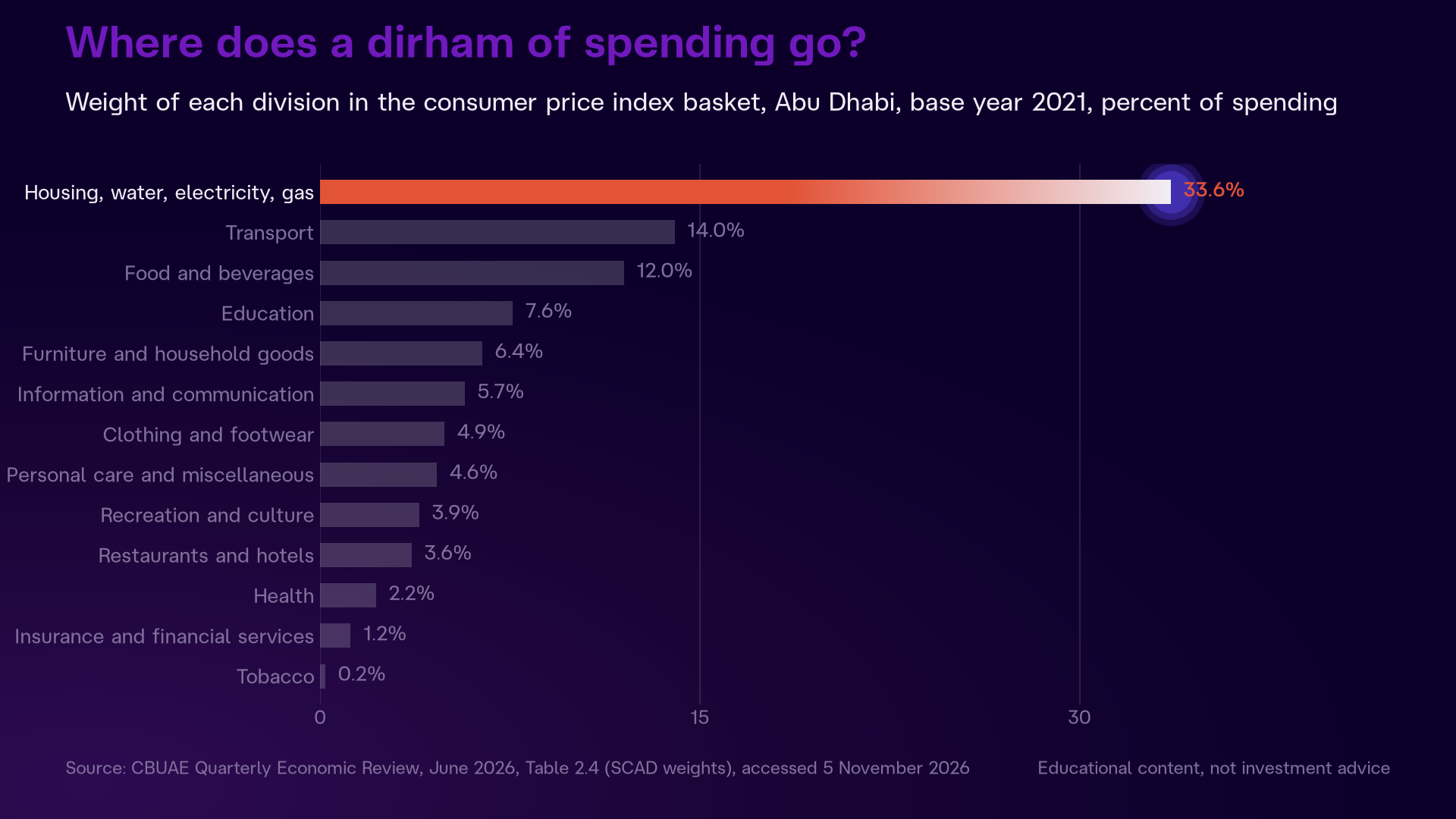
In the Abu Dhabi consumer price index basket, housing, water, electricity and gas take 33.6% of spending, transport 14% and food and beverages 12%, according to Statistics Centre Abu Dhabi (base year 2021). Housing, transport and food alone come close to six dirhams in every ten a household spends. Dubai looks similar: housing weighs 37.6% in the same table of the Central Bank's Quarterly Economic Review for June 2026. The basket measures consumption spending only, not savings and not purchases of homes or shares, so it is a picture of what is spent, not of a full budget.
That is why the 50% bucket fills up fast. A worked case, with assumed figures: a salary of 10,000 AED and an annual rent of 54,000 AED paid monthly, so 4,500 AED a month, which alone is 45% of the salary. With 2,500 AED for electricity, water, transport, groceries and phone, needs come to 7,000 AED, 70% instead of 50%. That leaves 3,000 AED for wants and savings together.
The rule does not break here; it turns into one clear question: how do we split the 3,000? Two options, as examples, and every household has its own:
- Keep savings at 2,000 AED (20%) and trim wants to 1,000 AED (10%).
- Keep wants at 2,000 AED and lower savings to 1,000 AED (10%), with the intention of raising it when the rent falls or the salary rises.
The real value of the rule is not the three numbers. It is that it makes us see rent as a share of salary before signing the lease, not after. And the closer rent gets to 40% of salary, the more the saving question becomes a housing question first: one room fewer, a district further out, or a lease paid in more cheques.
Where the savings go: an emergency fund first
An emergency fund is a sum that covers essential spending for three to six months, kept somewhere easy to reach, not invested and not touched except for a real emergency: income stopping, illness, or a major car repair. It is general practice in financial planning, not a product from any one institution.
In numbers: on a salary of 10,000 AED with needs of 5,000 AED, three months is 15,000 AED and six months is 30,000 AED. Saving 2,000 AED a month, the three-month fund is complete in seven and a half months and the six-month fund in 15 months. In the rent-heavy case (needs of 7,000 AED and savings of 1,000 AED) the three-month fund takes 21 months. That gap is what the rule shows plainly: every extra 1,000 AED saved a month shortens the wait by months.
Once the fund is complete, the 20% is free for goals further out: a housing deposit, education, or long-term investing, which is another topic. What happens to money that sits in a current account for years is in our post on inflation in the UAE year by year.
The salary-day habit: an automatic transfer on the 1st
The idea is simple: on the day the salary lands, the savings share moves automatically to a separate account before spending starts. In that order, saving becomes the first line item, not whatever is left. A standing transfer on a fixed date is a routine feature of bank accounts; it is enough to pick a date before the rent and the bills fall due.

What stays in the current account after the transfer is what needs and wants are paid from, and one check in the middle of the month is enough to see whether the rhythm holds.
Where to start this month
The rule needs no complicated spreadsheet and no tracking of every dirham. Three steps are enough for the first month:
- The net salary: the figure that actually lands in the account, without irregular allowances. That is the base the three percentages are worked on.
- The real needs: rent divided by 12, electricity and water from the last three months' bills, groceries, transport, phone, insurance, instalments. If the total passes 50%, that number itself is the most useful piece of information in the exercise.
- The savings amount and its date: 20% if possible, or any share that can be kept without slipping, transferred automatically on the first of the month.
After three months the picture is clear: if a surplus is left in the wants bucket it moves to savings, and if the needs bucket keeps overflowing the cause is usually one large line, which in the UAE is rent, a car instalment or school fees, and fixing one line does more than trimming ten small ones.
When the rule does not fit
- Variable income (commissions, freelance work): the percentages are applied to the average of the last six months, not to the best month.
- Existing debt: repaying the most expensive debt usually sits in the savings bucket rather than in wants, because it builds net worth.
- A salary that barely covers needs: the percentages become a gradual target; 5% saved is better than zero, and the direction matters more than the number.
- A high salary: on 30,000 AED, 30% for wants is 9,000 AED a month, and saving more than 20% becomes common because needs do not grow at the same pace.
More questions about salary and saving are on our FAQ page. End of service gratuity is not part of the monthly salary; how it is calculated is in our post on end of service gratuity in the UAE.
Common mistakes
- Working the percentages on the gross salary before deductions, or on a salary that includes allowances that may not be paid every month.
- Treating savings as "what is left at the end of the month": in most months nothing is left, and the transfer on day one is the fix.
- Putting rent in the needs bucket and forgetting that the 50% also has to cover food, transport and bills.