

End of service gratuity in the UAE private sector is calculated on the last basic salary, not the total salary: 21 days' wage for each of the first five years, then 30 days' wage for each year after that, provided at least one continuous year was completed, and capped at two years' wage. That is Article 51 of Federal Decree-Law No. 33 of 2021, and the rule is the same on resignation and on termination by the employer.
A worked example: basic salary AED 8,000, seven years of service
The basic salary is AED 8,000 and the service is seven full years with no unpaid leave. The calculation takes four steps:
- Daily wage: 8,000 ÷ 30 = AED 266.67. The law counts a month as 30 days in all its calculations (Article 67).
- First five years: 21 days × 266.67 = AED 5,600 per year, so AED 28,000 for five years.
- Years six and seven: 30 days × 266.67 = AED 8,000 per year, so AED 16,000.
- Total: 28,000 + 16,000 = AED 44,000.
The cap is two years' wage, which here is at least AED 192,000 (24 months of basic salary), far above the computed amount. Had the service been seven years and six months, the half year is added in proportion and the gratuity becomes AED 48,000 instead of 44,000, because the law counts parts of a year pro rata once the first year is complete.
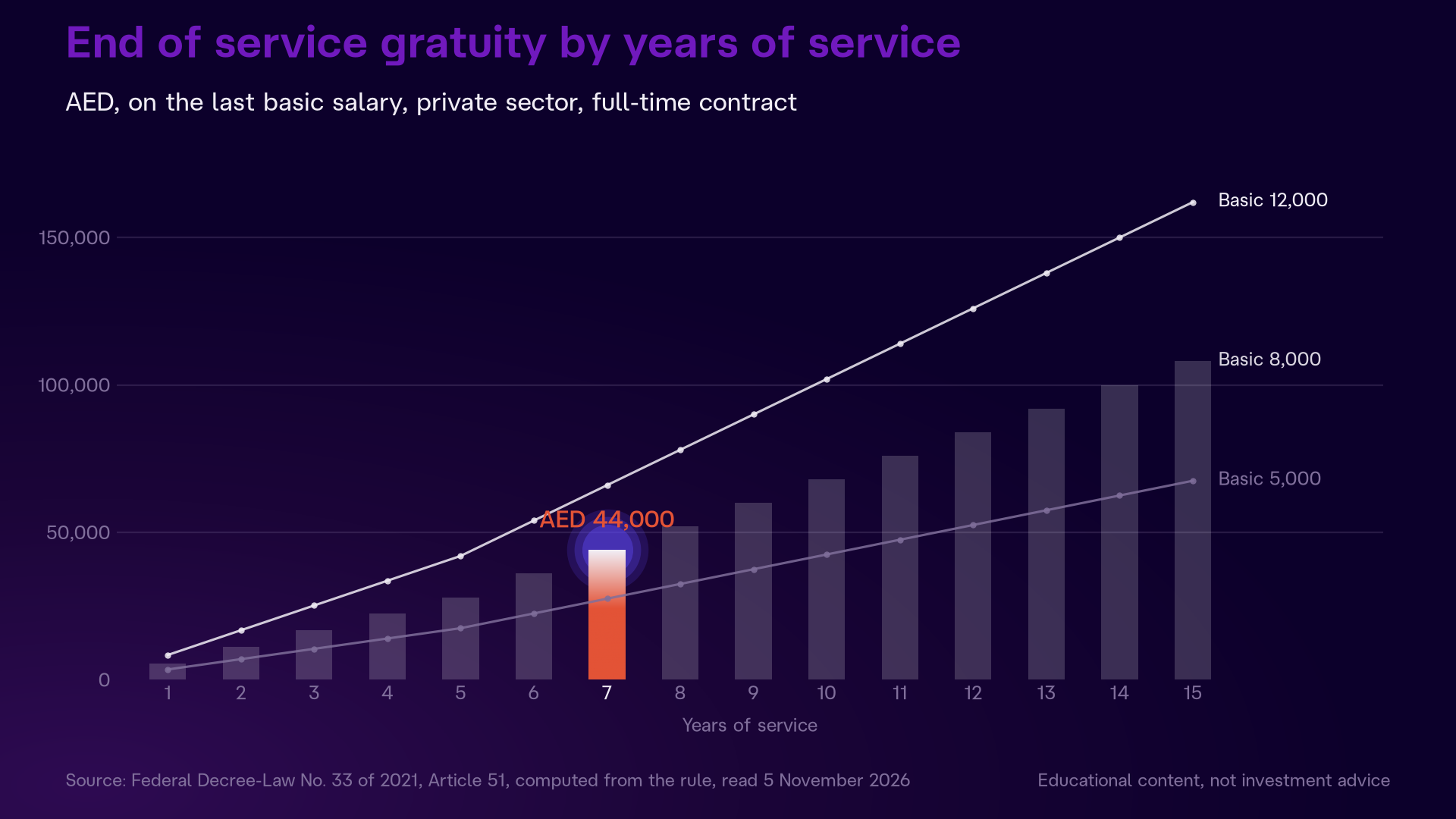
A quick read of the chart: five years on a basic salary of AED 8,000 give AED 28,000, three and a half months of basic salary, while 15 years on the same salary give AED 108,000, thirteen and a half months. One year on a basic salary of AED 5,000 gives AED 3,500, and on AED 12,000 it gives AED 8,400.
What goes into the calculation and what stays out
Four inputs set the amount, and each one has a line in the law:
Basic salary alone. Article 1 defines the basic wage as the wage named in the employment contract without any allowances or benefits in kind. Housing, transport, ticket and every other allowance stay out of the gratuity. On a contract with a total of AED 12,000 and a basic of AED 8,000, the gratuity is calculated on 8,000 only: AED 44,000 after seven years, not AED 66,000. That is why the basic salary line deserves a careful read at signing; it sets the gratuity years later.
The last basic salary. Article 51(5) calculates the gratuity on the last basic wage earned before the end of service, not on an average of the years. A basic salary increase before leaving raises the gratuity for every earlier year, and a decrease lowers it the same way.
Continuous service, less unpaid leave. Continuous service is uninterrupted service with the same employer or its legal successor, and a contract renewal does not break it (Article 8). Days of absence without pay do not count towards the service period (Article 51(4) and Article 33). In the same example, 60 days of unpaid leave across the seven years cut the counted service to about 6.84 years and the gratuity to about AED 42,685.
The cap. The total gratuity cannot exceed two years' wage (Article 51(6)). On a fixed basic salary the calculation does not reach that ceiling before about 25 years of service, so it rarely bites, but it exists.

Resignation, dismissal, deductions and the payment date
Article 51 does not distinguish between someone who resigned and someone whose contract was ended: the same rule, the same days. Even dismissal as a disciplinary sanction appears in Article 39 with the words "while preserving the worker's right to end of service gratuity", and the compensation for unlawful termination in Article 47 is added to the gratuity rather than replacing it.
What may be deducted from the gratuity is listed in Article 29 of the Executive Regulation (Cabinet Resolution No. 1 of 2022): loans and amounts paid in excess of what was due, debts under a court judgment, fines under a penalty list approved by the Ministry, and the cost of repairing damage proven to be the worker's fault or breach of instructions. Outside that list, no deduction.
The date is fixed too: the gratuity and all other entitlements are paid within 14 days of the end of the contract (Article 53). Unused annual leave is paid in cash on the basic salary (Article 19 of the Executive Regulation), a separate item added on top of the gratuity. And everything in the law is a minimum: a contract or company scheme that gives more applies (Article 65).
The alternative savings scheme: how it works
Since Cabinet Resolution No. 96 of 2023, a private sector or free zone employer may voluntarily join an alternative savings scheme in place of the traditional gratuity. Under it, the employer pays a monthly subscription into a licensed investment fund: 5.83 percent of the monthly basic salary for an employee who has not completed five years, and 8.33 percent after that. The two rates are not arbitrary: 21 days out of 30, divided by 12 months, is 5.83 percent, and 30 out of 30 over 12 is 8.33 percent, the same accrual spread across the months. On a basic salary of AED 8,000 the subscription is AED 466 a month before five years and AED 666 after.
What changes is where the money sits and what the result looks like. Instead of a sum calculated at the end on the last basic salary, monthly subscriptions accumulate with the fund's result, which can be positive or negative depending on the investment option, and are paid within 14 days of the end of service. The resolution requires every fund to offer a capital preservation option, which is compulsory for unskilled workers, alongside options with different levels of risk and Sharia-compliant options. The employee may add a voluntary subscription from their own salary, capped at 25 percent of total wage. The decision to enrol belongs to the employer, and the gratuity earned for the period before enrolment is calculated on the basic salary at the time of enrolment and paid at the end of service. Choosing between the two systems depends on each case; this section explains the mechanism only.
Who this rule applies to
Article 51 covers the non-national worker on a full-time contract in the private sector under the Ministry of Human Resources and Emiratisation. UAE nationals in the private sector come under the pensions and social security legislation. Employees of federal and local government bodies are outside this law and have their own systems. The two financial free zones, the Dubai International Financial Centre and Abu Dhabi Global Market, have their own end of service rules, which this article does not cover. Part-time and job-sharing contracts earn a share of the full-time gratuity in proportion to the annual working hours in the contract (Article 30 of the Executive Regulation), and temporary work shorter than a year earns no gratuity.
The gratuity is one amount that arrives once, after years, and knowing its real size puts it in its proper place next to what is saved from the salary each month, which is the subject of How to split your salary. What that amount can buy years later is the subject of Inflation in the UAE year by year. Other questions about how we work are answered on the FAQ page.
Common mistakes
- Calculating the gratuity on total salary instead of basic salary. In the example above the difference is AED 22,000, and the law is clear that allowances stay out.
- Multiplying the monthly salary by the number of years. Twenty-one days' wage is 0.7 of a monthly salary, not a full one, and the full month only starts from the sixth year.
- Assuming resignation cancels the gratuity, or counting unpaid leave in the service period. The rule is the same on resignation and termination, and unpaid days are removed from the period before the calculation.