

A share is, at its root, a slice of ownership in a company, and most contemporary Sharia boards treat buying one as permissible on two conditions: the company's core activity is permissible, and its dealings with interest stay within narrow limits, with the shareholder purifying whatever non-compliant income reaches them. The best known limits are those of Shari'ah Standard No. 21 of the Accounting and Auditing Organization for Islamic Financial Institutions (AAOIFI): interest-bearing debt not exceeding 30% of market capitalisation, interest-bearing deposits not exceeding 30% of market capitalisation, and non-compliant income not exceeding 5% of total income. Some scholars accept only companies that neither borrow nor deposit on interest at all, so what follows explains how the screening works and what its numbers mean. It is not a fatwa and not a recommendation on any share.
A worked example: hypothetical Company A
Take a company we will call Company A. It is hypothetical, its figures are invented for the explanation, and it stands for no real company. Market capitalisation AED 10 billion, 2 billion shares, so AED 5 a share.
Screen 1: its core business is retail, a permissible activity, so it moves on to screen 2.
Screen 2, against the AAOIFI limits:
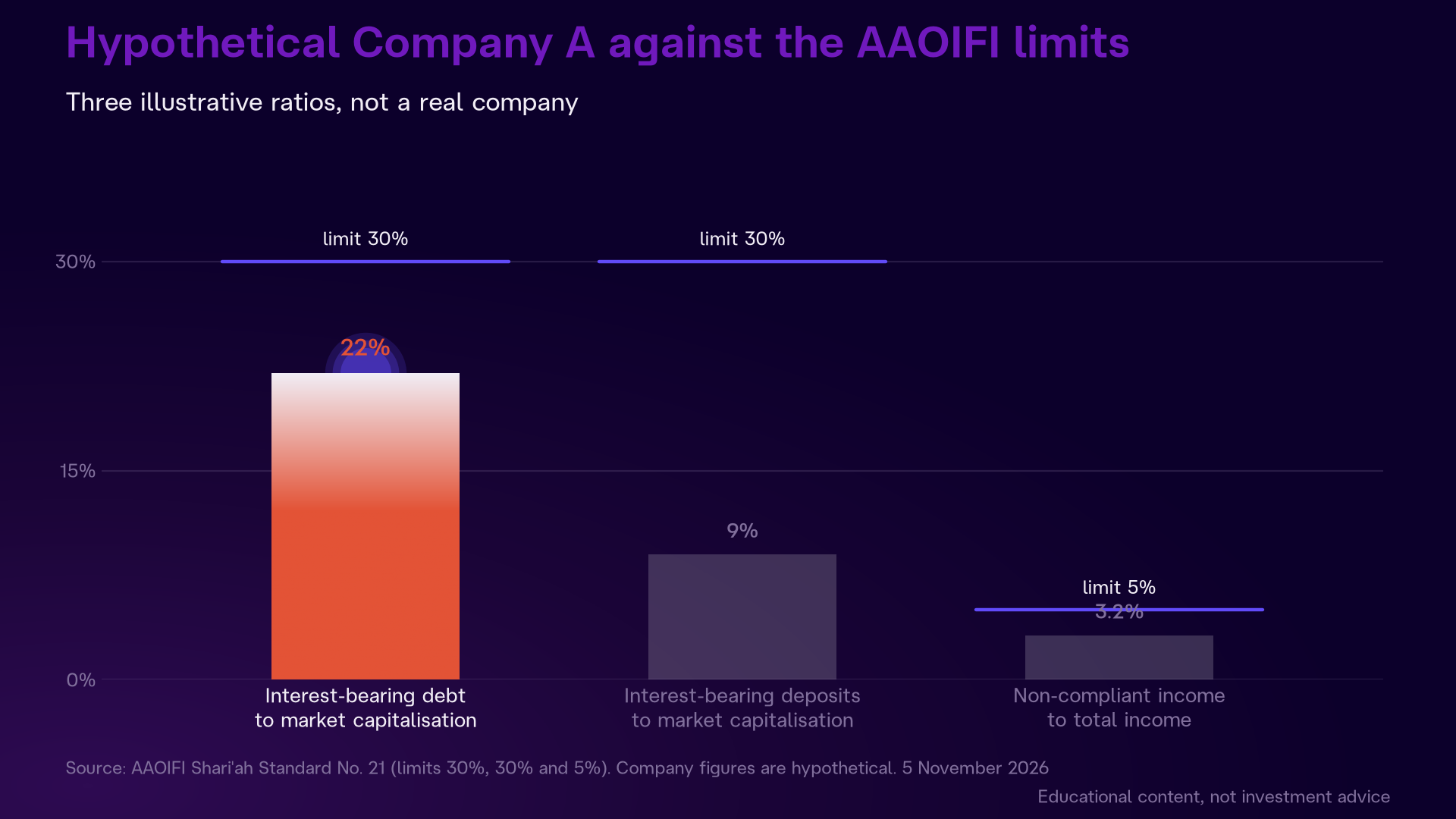
- Interest-bearing debt AED 2.2 billion, which is 22% of market capitalisation. Limit 30%. Passes.
- Interest-bearing deposits AED 900 million, 9% of market capitalisation. Limit 30%. Passes.
- Non-compliant income AED 96 million out of total income of AED 3 billion, 3.2%. Limit 5%. Passes.
Result this quarter: compliant under the AAOIFI limits. The ratio closest to its limit is debt, with only 8 percentage points to spare, which is what the chart shows.
Screen 1: what does the company do?
The first question is not about numbers but about where the profit comes from. If the core activity is prohibited, such as conventional interest-based banking, conventional insurance, alcohol, pork, gambling, tobacco or adult content, the share drops out here however good its ratios look. A brewery with no debt is still a brewery.
Most methodologies also cap incidental income from such activities: MSCI's Islamic methodology and the FTSE Yasaar ground rules both exclude a company whose revenue from prohibited activities exceeds 5% of total revenue, even when its core business is permissible.
At this stage the company's annual report and its segment breakdown are read, not just its name. A company whose name suggests food can own a hotel division or an interest-based financing arm.
Screen 2: the three financial ratios
Most listed companies, even those with permissible businesses, borrow on interest or park spare cash in interest-bearing deposits. The ratio question is: how large is that dealing relative to the size of the company? AAOIFI's Shari'ah Standard No. 21 sets three limits:
- Interest-bearing debt, short and long term, does not exceed 30% of the company's market capitalisation.
- Interest-bearing deposits and investments do not exceed 30% of market capitalisation.
- Non-compliant income, such as interest and revenue from an incidental prohibited activity, does not exceed 5% of total income.
The standard says plainly that borrowing and depositing on interest are prohibited whatever the amount; the ratios are not a licence for the company but a limit for a shareholder who does not control its decisions. The shareholder keeps observing these conditions throughout the holding, and if they can no longer be met the investment has to be given up.

Purification: how it is worked out in dirhams
Passing both screens does not make all the income permissible. The non-compliant slice that the 5% limit tolerated has to be given away to charity, and that step is called purification.
AAOIFI's method: divide the company's total non-compliant income by its number of shares, then multiply by the shares held. For Company A: AED 96 million over 2 billion shares is AED 0.048 a share. A holder of 5,000 shares (worth AED 25,000 at AED 5) at the end of the financial period purifies 5,000 times 0.048, which is AED 240. Under AAOIFI the duty applies whether or not the company paid a dividend and whether it made a profit or a loss, and the amount may not be used for the holder's benefit, not even to pay taxes.
The index providers' method: S&P and MSCI publish a purification ratio applied to dividends only: dividends received times the share of non-compliant income in total income. The same holder, who received AED 2,500 in dividends (5,000 shares times AED 0.50), purifies 2,500 times 3.2%, which is AED 80. The gap between AED 240 and AED 80 is not an arithmetic error but a difference of method, which brings us to the next question.
Why does the answer differ between apps, and from one quarter to the next?
Because the scholars differed first. The International Islamic Fiqh Academy resolved in 1992 that the default ruling on companies with a permissible business that sometimes deal in riba is prohibition, and in 1995 it postponed a ruling on such companies pending further study. AAOIFI's standard followed in 2004 with the limits above, and the Sharia boards at the index providers adopted limits that are close but not identical.
The second difference is the denominator, the number you divide by. AAOIFI measures debt against current market capitalisation. The S&P Shariah indices measure it against a 36-month average market value of equity with a 33% limit, as published in their methodology; the Dow Jones Islamic Market indices against a 24-month average market capitalisation with a 33% limit; while MSCI Islamic and FTSE Yasaar measure debt against total assets with a 33.33% limit. The same company can pass one measure and fail another. The 5% limit on non-compliant income is the one point almost everyone shares.
The third difference is time. The ratios come from the latest financial statements and the market price, so they move every quarter. If Company A's debt stayed at AED 2.2 billion and its market capitalisation fell 30% to AED 7 billion, its debt ratio would rise to 31.43% and it would fail the AAOIFI debt screen that quarter without the company changing anything. That is why methodologies rescreen every three months, and why two apps can disagree on the same day. The Rethink app includes a free Sharia stock screener for the Gulf and US markets that applies the AAOIFI methodology.
All of the above is information about how screening works, not a fatwa on any particular share and not a recommendation to buy or sell it. Certainty about a particular case comes from asking a trusted scholar or Sharia board. Short answers to first investing questions are on the FAQ page, and zakat on shares is a separate matter, covered in zakat nisab in dirhams.
Common mistakes
- Judging by the name or the sector: a telecoms or food company can own an interest-based financing arm or hotels; the financial statements decide, not the name.
- Treating a screen result as permanent: a share that is compliant today can fail next quarter because of a new loan or a fall in price, and the screen is repeated with every set of financial statements.
- Skipping purification, or taking 5% of all profits: the amount is worked out from the company's actual non-compliant income per share, not from the whole profit and not from the capital.