

The zakat nisab for money in the UAE is the value of 85 grams of 24K gold, according to the zakat calculator of the General Authority of Islamic Affairs, Endowments and Zakat. On 5 November 2026 the calculator used AED 498.5 per gram, which put the nisab at AED 42,372.50. Anyone who holds that amount or more for a full lunar year pays 2.5 percent of the total, the same as dividing the total by 40.
A worked example: AED 40,000 saved for a full year. Take savings of AED 40,000 that stayed in the account for a full lunar year. Step one, the nisab: 85 x 498.5 = AED 42,372.50 at the Authority's calculator price on 5 November 2026. Step two, the comparison: 40,000 is below 42,372.50, and the Authority's calculator itself answered that day that no zakat is due because the total is below the nisab. Step three, if the amount were above the nisab: zakat is the amount x 2.5 percent. On AED 40,000 that equals AED 1,000. On AED 50,000, an amount above the nisab that day, it equals AED 1,250, which is the figure the Authority's calculator returned.
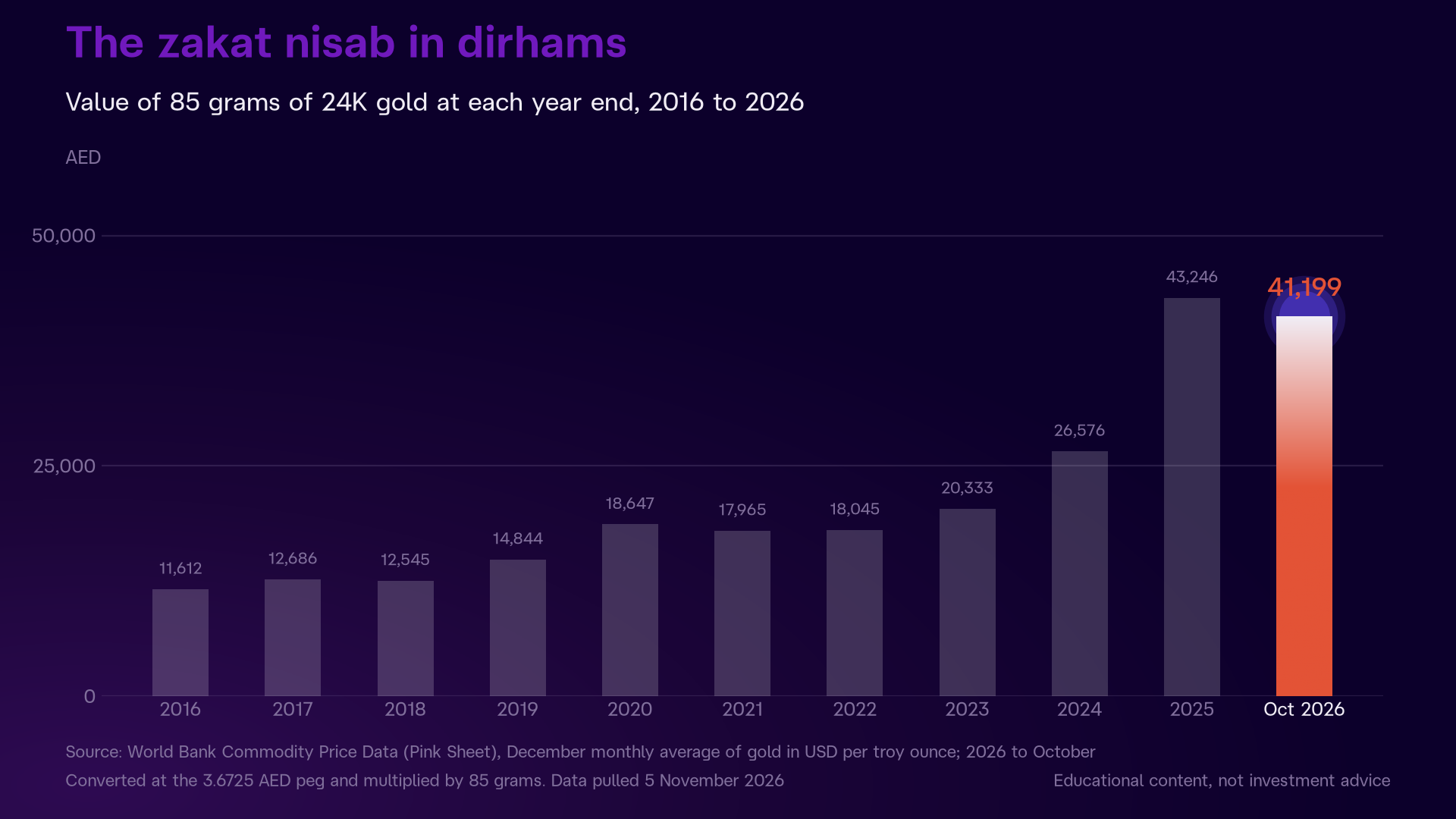
The twist is the whole lesson. The same AED 40,000 was above the nisab in December 2023, when the nisab was about AED 20,333 by our calculation from World Bank data, and sat below it in November 2026. The nisab moves with the gold price, and the comparison is made at the price on the zakat due date, not a price kept from an earlier year.
How the nisab is calculated and why it changes every year
The rule is fixed and the number moves. The rule, as the Authority publishes it: the nisab for money is the equivalent of 85 grams of gold, and the zakat rate on money is a quarter of a tenth, 2.5 percent. The number moves because the price of a gram moves.
The chart above shows the effect. In December 2016 the nisab was about AED 11,612. In December 2023 it reached AED 20,333. In December 2025 it stood at AED 43,246, and in October 2026 at AED 41,199. The nisab grew about three and a half times in ten years. These figures are computed from the World Bank's monthly average gold price per troy ounce, converted to dirhams at the 3.6725 peg, divided by 31.1035 grams per ounce, then multiplied by 85. Past performance does not guarantee future results, and this chart says nothing about the price of gold tomorrow.
Why do the figures differ slightly from one source to another? Because the gram price depends on the day and the source. On 4 November 2026 Gulf News published an evening price of AED 487.50 per gram of 24K, provided by the Dubai Gold and Jewellery Group, which gives a nisab of AED 41,437.50 at that price. The Authority's calculator the next day used AED 498.5. The gap is about AED 900 in the nisab, and it matters to anyone whose savings sit close to the line. For anyone calculating through the Authority's service, the Authority's figure is the reference.
What counts as "savings"
Savings here means all the money owned, wherever it sits: the current account balance, the savings account, cash at home, balances in payment wallets, and foreign currency at its dirham value on the day of the calculation. The Authority notes that the nisab differs by the type of wealth, which is why its calculator has separate tabs for money, gold, silver, shares, companies and others, each with its own method. This post is about the money tab alone.
What is used for daily living, such as the home, the car and furniture, is usually not counted as zakatable wealth, and saved gold has its own tab by weight. For anyone who sets aside a fixed share of salary each month, as in the 50/30/20 rule, the total is easy to track when the savings sit in one account with a known balance.
The year: when it starts and when it is counted
The hawl is one full lunar year of ownership, the Authority's second condition after the nisab. The Authority's FAQ answers a very common case: money that rises and falls during the year. Its answer: the year starts on the day the money first reaches the nisab, and neither increases nor decreases harm after that unless the money falls below the nisab; if it does, the year is counted again from the day it returns to the nisab.
In practice this means that someone whose salary arrives every month does not need a separate year for each payment; the total on the due date is what is counted. The lunar year is about 354 days, roughly 11 days shorter than the Gregorian year, so a zakat date fixed on the Hijri calendar falls about eleven days earlier each Gregorian year. Anyone who uses the Gregorian year finds a second option on the Authority's calculator at 2.577 percent instead of 2.5 percent, to make up for the extra days; on AED 100,000 the calculator gives AED 2,500 for the Hijri year and AED 2,577 for the Gregorian one.
Many people tie their zakat date to Ramadan because it is easy to remember. Ramadan 1448 is expected on 8 February 2027 by astronomical calculation, and the moon sighting decides. Anyone who picks that date needs the gold price of that day, not today's.
Where scholars differ, and who to ask
The calculation above is the Authority's method as it publishes it. Zakat also has questions on which scholars and schools differ, and we issue no ruling on them; we name them so that the right question can be asked:
Gold or silver nisab. The Authority uses the value of 85 grams of gold for money and states a silver nisab of 595 grams. At October 2026 prices the silver nisab is about AED 4,004 by our calculation from World Bank data, roughly a tenth of the gold nisab. Some scholars and charities prefer the silver nisab for money because it benefits the poor more. On AED 40,000 that choice changes the answer from "no zakat" to AED 1,000.
Debts. Views differ on deducting debts owed by the person from the total, and on zakat on money lent to others. Jewellery worn for adornment is another question on which the schools differ.
For these cases, the Authority's zakat calculation service is free and takes about ten minutes according to its service page, through the call centre 8008222, the app or the website. The Zakat Fund, which used to be a separate body, has been part of the Authority since Federal Law No. 2 of 2024, so it is one and the same body. Asking a trusted scholar remains open for every case. What we do at Rethink is explain the arithmetic, as in the rest of the FAQ and the instructor page.
Common mistakes
- Calculating the nisab at an old gold price, or at the 21K or 22K price instead of 24K. The nisab is measured in pure grams at the price on the due date.
- Counting a Gregorian year as a lunar year without adjustment. The difference is about 11 days every year, and the Authority's calculator offers an option for each calendar.
- Forgetting scattered balances: payment wallets, foreign currency accounts, cash at home. The total is what is compared with the nisab.